


Don't Hate the Player, Hate the Game


Hello,
You know the type. The coworker who feels like the only one who is not holding up their end of the bargain. The leader who lacks a backbone. The teammate who seems to think there is an I in TEAM.
Naming the person feels productive. It gives us someone to focus on. Someone to fix.
But what if the behavior we are frustrated by is not a personal failing at all? What if it is exactly what the system is designed to produce?
When Someone Acts Badly, a Good System Does Not Look Away
Imagine you are at a professional development session where people are seated at tables, having structured conversations. Nothing remarkable. You have been in rooms like this before. Now imagine a facilitator walks by, pauses at a table, and asks a routine clarifying question. Then, out of nowhere, a coworker at that table suddenly raises their voice and starts yelling.
That is exactly what happened to me.
During a large meeting, participants were seated at tables having structured conversations. A facilitator, who was also an employee, was circulating to support groups. When she stopped at one table and asked a routine clarifying question, someone at the table suddenly began yelling at her. The tone was aggressive and completely inappropriate. Everyone heard it. No one knew what triggered it. What made it even more jarring was that they were colleagues.
The facilitator did not escalate the situation. She stayed composed and walked away. Later, I checked in with her. She said she was okay, though understandably confused by the outburst.
Though I was new to the team, I knew this behavior was not okay, not just in my eyes, but in the eyes of the organization. During new hire orientation, respect and professionalism had been named as expectations, not aspirations. What mattered now was whether those expectations would hold when they were challenged.
I am not the integrity police. I was simply someone who bore witness to behavior that crossed a line. In some organizations, when moments like this are raised, the person who speaks up becomes the problem, and I would be lying if I said that concern did not cross my mind. After some reflection, I realized that staying silent felt worse than saying something. I did not need to be the integrity police to be an upstander.
When the incident was brought to HR, the response was neither punitive nor dismissive, for me as the person reporting it or for those directly involved. The response was curious and corrective. The facilitator was interviewed. Witnesses were consulted. A meeting was held with HR, the facilitator, and the person who had yelled. The goal was not punishment, but understanding, accountability, and repair. Both people left feeling seen. Expectations were clarified. In short, the system did what it was designed to do.
In Broken Systems, Silence Becomes the Safest Response
Now imagine that same moment in a different environment.
Someone raises their voice. People notice, but no one says anything. Those who consider speaking up decide it is safer not to. If the behavior is reported, it is minimized. “That is just how they are.” Or justified. “They were under a lot of stress.” Or deflected. “This is not really an HR issue.”
Over time, the lesson becomes clear. The problem is not the behavior, the problem is naming it. That is how broken systems train people. Overtly or quietly, the system yields the results it is set to achieve.
A colleague and I recently talked about a teacher we both know who is exceptional. Innovative. Creative. The kind of educator you would want teaching your own children. The kind of professional schools say they want to keep. However, in her building, she is treated as a threat. Colleagues are intimidated by her work. She is subtly pressured to stay in her lane.
Regrettably, in flawed systems, systemic failures affect everyone, including leaders. Her principal wishes to support her but is unable to do so. He is under scrutiny from his supervisor and lacks support. Teachers go over his head when they have issues. His authority is only in name rather than in action. It would be easy to label this principal a weak leader. But the system tells a different story. It isolates an innovative teacher, strips a principal of meaningful authority, and then blames both for outcomes it made inevitable.
Systems Are Always Teaching Us What Is Safe and What Is Not
Systems teach people how to survive inside them. They teach through what gets addressed and what gets ignored, through who is protected and who is exposed, and through whether speaking up leads to dialogue or consequences.
In functioning systems, people learn that respect is real, accountability is consistent, and doing the right thing is supported. In broken systems, people learn that silence is safer than honesty, innovation is risky, and quid pro qou matters more than ethics. People adapt accordingly.
What distinguishes a functioning system from a broken one is not whether conflict ever occurs. Conflict happens everywhere. The difference is how the system responds when it does. By the time we are frustrated with a person, the system has usually already failed. The outburst in a meeting, the silenced innovator, the powerless leader, none of these are starting points. They are symptoms that tell us far more about the environment than about the individual.
In functioning systems, inappropriate behavior is addressed directly and proportionally. Speaking up leads to conversation, not retaliation. Accountability is paired with clarity and dignity. Leaders are supported when they uphold expectations, and repair is possible without public shaming.
In broken systems, the opposite patterns take hold. Harm is minimized or explained away. Those who raise concerns are labeled as difficult or disloyal. Leaders hesitate or deflect because they lack backing. Over time, people learn that silence is safer than honesty and compliance is safer than care.
These patterns are not accidental. They are learned responses to what the system rewards, tolerates, or punishes. Blaming the people and not the system is a common mistake. We zoom in on behavior without zooming out on design. We ask people to be more resilient, more professional, more flexible, more patient, while leaving intact the conditions that make those traits nearly impossible to sustain.
Systems decide who is protected and who is exposed. They decide whether accountability feels fair or dangerous. They decide whether leadership is real or symbolic. Since systems operate quietly, we often do not notice their influence until good people start burning out, disengaging, or leaving.
This is why changing individuals rarely produces lasting change. The system simply trains the next person in line to behave the same way. New faces, same outcomes. So when something is not working, the most important question is not who caused the problem, but what conditions produced it.
After all, systems are not neutral. They are perfectly designed to get the results they are getting. So if we want different results, we cannot just keep swapping out players, we have to change the game.
~Heather
P.S. Have you heard of the Mood Meter, developed by Marc Brackett.
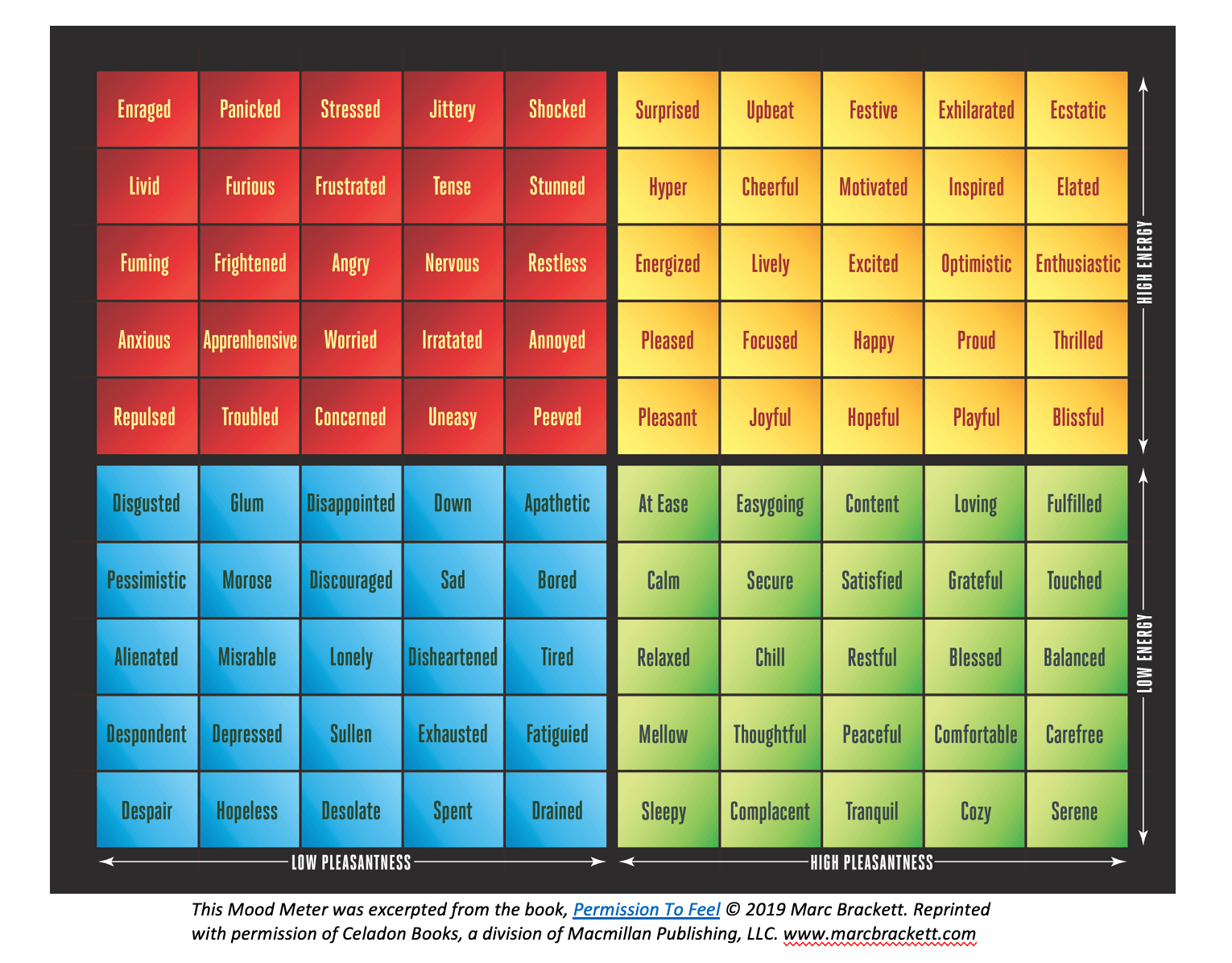
It was originally created for kids, but it turns out many adults struggle just as much to accurately name what they are feeling. Most of us can tell whether we feel good or bad, pleasant or unpleasant. Brackett takes that familiar instinct one step further by adding a second dimension: energy. Do you feel like taking action, or do you feel like pulling back?
That simple framework unlocks something powerful. When you can name not just how you feel but the level of energy behind it, emotions become more specific and more workable. Irritation is different from anger. Contentment is different from excitement. With better labels comes better choices.
The more fluent we become with this kind of emotional vocabulary, the more agency we gain. We can respond instead of react. We can adjust our environment, our expectations, or our behavior with intention. What started as a tool for classrooms ends up being just as useful in meetings, relationships, and leadership. Simple, practical, and surprisingly clarifying, the Mood Meter is this week's Catch of the Week!
P.P.S. Please remember to...
Like and share this post
Check out other posts
Subscribe to www.lyonsletters.com
Buy and rate your copy of Engagement is Not Unicorn (It's a Narwhal),
From Amazon or Barnes & Noble


Comments